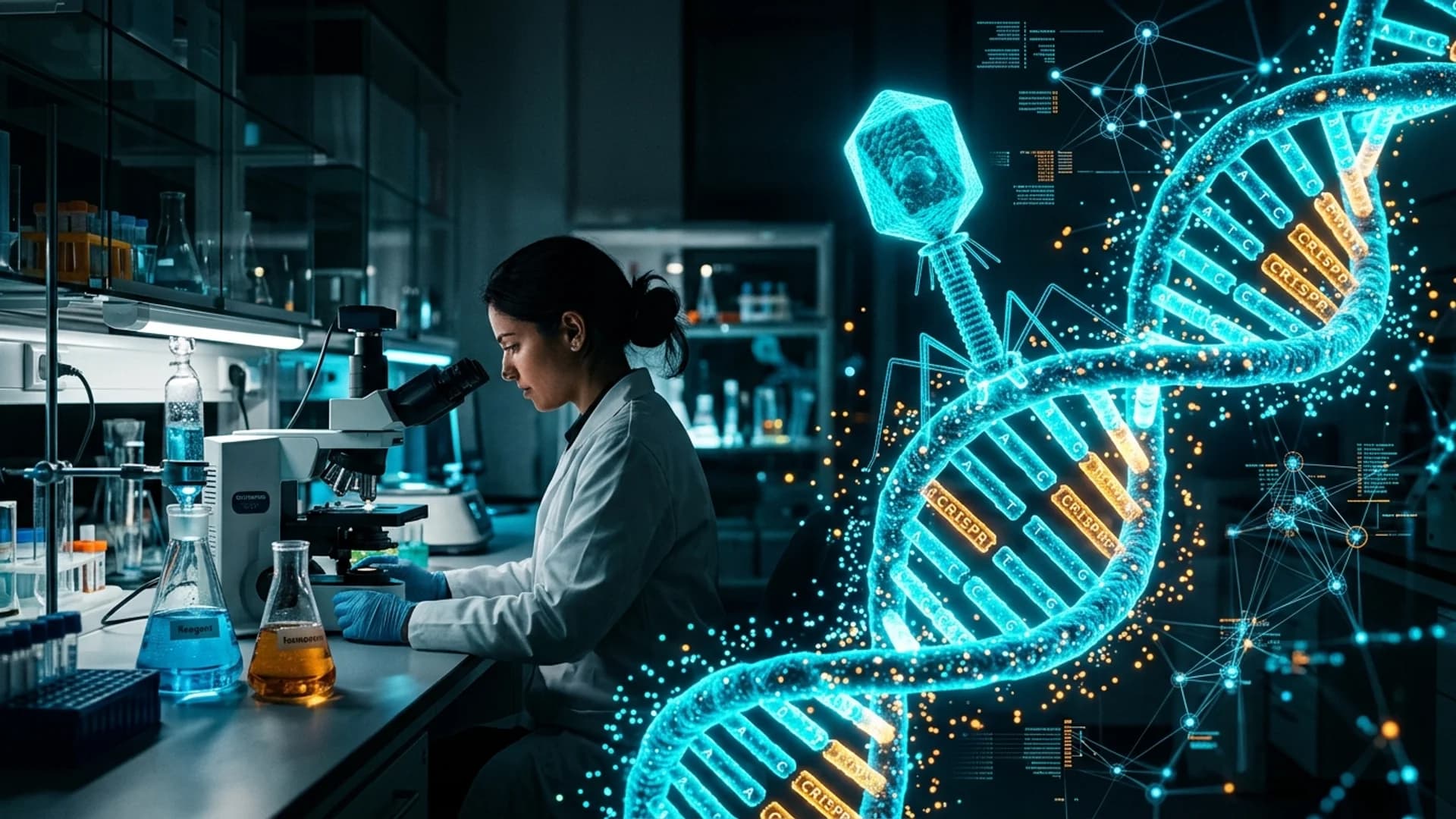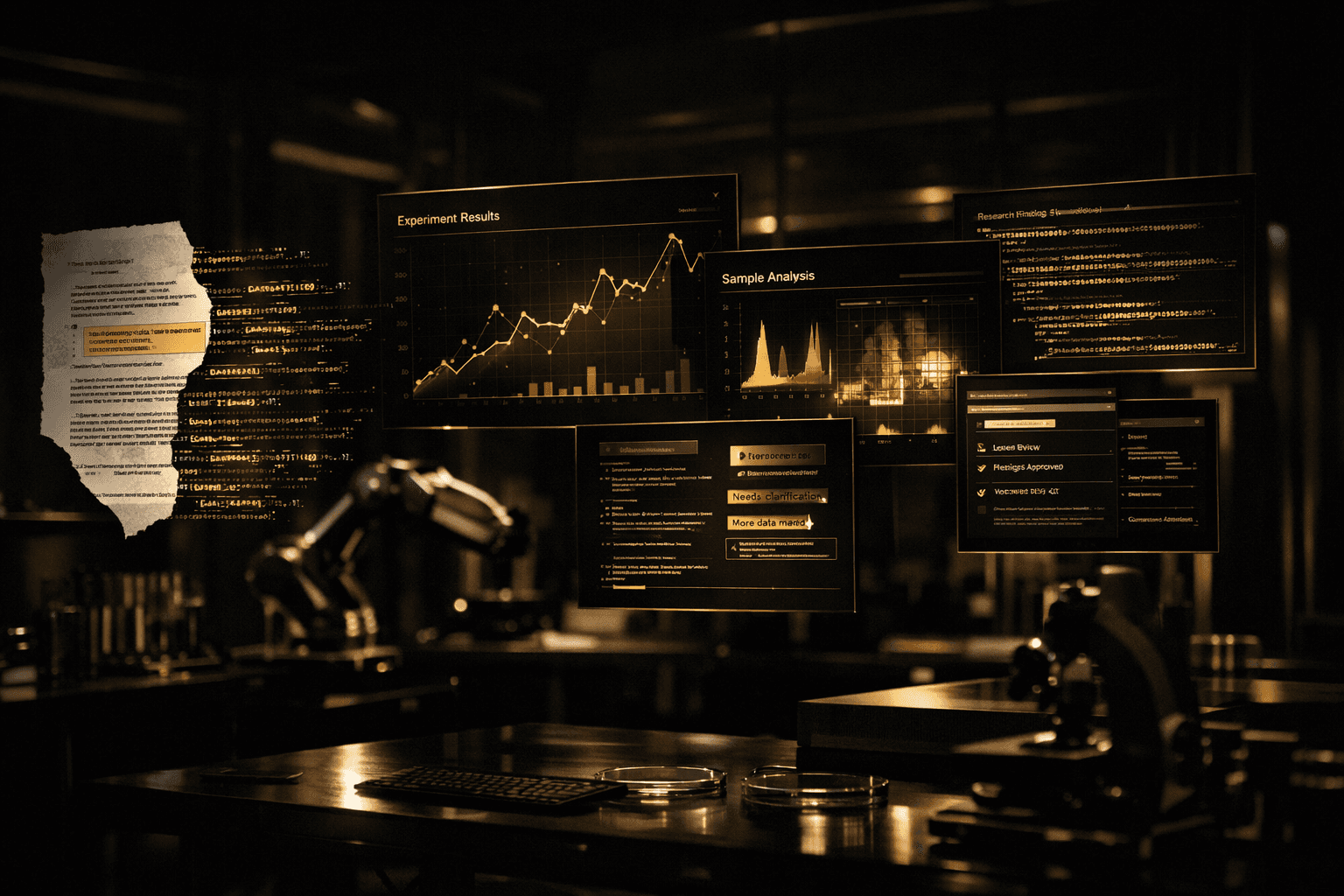
The headline hides the real shift
The symbolic milestone is obvious enough: a system did not merely assist with one narrow task. It moved across multiple stages of research and produced something that reviewers judged worthy of acceptance in a workshop setting.
But the real change is not the scientific brilliance of the result. Even Nature’s accompanying editorial makes that point. The startling part is less the discovery itself than the way the work was produced. In other words, the disruption is procedural before it becomes intellectual.
That is the kind of transition people usually underestimate.
Whenever an expert activity starts to move from craft to pipeline, the consequences spread far beyond the initial demo. Costs drop. Throughput rises. Quality control becomes a strategic bottleneck. Standards matter more. Spam becomes easier. Infrastructure becomes king.
Science may be entering that phase.
Research is starting to leave the workshop and enter the factory
✦
For a long time, scientific work has been treated, rightly, as a deeply human craft. Not because every part of it is mystical, but because so much of it is messy, contextual, slow, and dependent on judgment. A good scientist does not simply execute steps. A good scientist chooses problems, filters noise, frames hypotheses, detects bad assumptions, and knows when a result is technically correct but intellectually hollow.
That remains true.
But not every layer of research carries the same kind of cognitive weight.
A large share of modern scientific work, especially in computational fields, includes repeatable operations: benchmarking, implementation, ablation testing, literature synthesis, result formatting, baseline comparisons, first-pass drafting, structured revision. Once AI systems can reliably chain those tasks together, a meaningful portion of research stops looking like a handcrafted artifact and starts looking like an orchestrated software process.
That is the real industrial signal in this story.
The first wave will not replace the rare minds who define new paradigms. It will pressure the wide middle: the repeatable, optimizable, scalable parts of scientific production.
And that is already enough to reshape incentives.
The most vulnerable layer is not genius. It is average research.
✦
Public debate loves extremes. Either the machine is useless, or the scientist is finished. Reality is usually less theatrical and more disruptive.
What systems like The AI Scientist threaten first is not elite scientific intuition. It is the enormous body of standardizable research work that sits below that summit. Benchmark papers. Variants. method tweaks. repeated experiment cycles. literature-grounded iteration. draft-heavy production. first-pass reviews. These are not trivial tasks. But they are precisely the kinds of tasks that software tends to absorb once reliability crosses a certain threshold.
And when that threshold moves, the economics move with it.
Labs will not only compete on talent. They will compete on tooling, evaluation loops, data hygiene, orchestration layers, and validation discipline. The advantage will increasingly go to teams that can combine models, compute, scientific taste, and operational rigor into one tightly controlled workflow.
That sounds less glamorous than “AI discovers everything.” It is also much more plausible.
The limitations are real, but they are not comforting
✦
The authors themselves are cautious. The results came from a workshop, not the most selective main conference track. Only a portion of the generated papers were accepted. The system still suffers from naive ideas, methodological weaknesses, implementation flaws, hallucinations, and inaccurate citations. It currently operates in the world of computational experiments, not across the full rugged terrain of real-world science.
That matters.
But these limitations should not be read as reassurance. They should be read as a progress marker.
Too many people evaluate systems like this as if they were static objects. They are not. They are moving targets. Once a workflow starts to function at all, even imperfectly, it often improves quickly as better models, stronger retrieval, tighter tooling, and more robust evaluation are layered on top.
What looks mediocre in a still image can become highly consequential in motion. That is why the serious question is no longer, “Can AI help with research?” It clearly can.
The serious question is now, “Which parts of research are becoming operationalizable faster than our institutions are prepared to handle?”
Peer review is entering the same turbulence zone
✦
There is another reason this moment matters. Scientific publishing is not changing only on the author side. It is changing on the review side as well.
AI systems are increasingly capable of helping with structured, objective, and repetitive parts of peer review. They can flag missing controls, identify inconsistencies, summarize claims, compare manuscripts against references, and support reviewers on the more mechanical side of evaluation. Human judgment still matters most where originality, importance, and conceptual depth are concerned. But even that boundary may not stay fixed forever.
This creates a strange symmetry.
AI is starting to participate in the production of papers, and also in the filtering of papers. The authoring pipeline shifts. The reviewing pipeline shifts. Eventually, journals, conferences, and labs will have to adapt not only to stronger tools, but to a scientific ecosystem in which both generation and evaluation are partially machine-mediated.
That is not a side effect. That is structural change.
The winners will not just have better models
✦
The next phase of this story will be misunderstood if we frame it as a pure model race.
The organizations that win in this environment will not necessarily be the ones with the most impressive demo. They will be the ones that build the strongest scientific operating system around their models. Better workflows. Better internal benchmarks. Better datasets. Better experiment tracking. Better guardrails. Better review loops. Better governance.
In short, better discipline.
That is true for research labs, but it is also true for products. Because once research becomes more pipeline-like, its outputs become easier to convert into tools, faster to iterate, and more scalable to deploy. The line between scientific production and product infrastructure gets thinner.
This is why the headline matters beyond academia. It is not just about whether an AI wrote a paper. It is about whether scientific work is starting to become software.
Verdict
✦
2026 is probably not the year AI replaces great scientists. It may be the year it starts to absorb standardizable research work at meaningful scale. That is already a major shift.
Because once research becomes even partially automatable, it also becomes faster, cheaper, more scalable, easier to systematize, and easier to flood with low-quality output. The promise and the mess arrive together. As usual, they travel in the same box.
The real shock is not that a machine crossed peer review.
The real shock is that science may be starting to industrialize from the inside.