
For two years, the EU AI Act has mostly existed in product conversations as a date in the future.
That phase is over.
On August 2, 2026, enforcement powers for important parts of the regulation began to apply. The European Commission and national authorities can now enforce provisions covering prohibited AI practices, transparency requirements for certain AI systems, and rules applying to general-purpose AI models.
This does not mean every AI product in Europe woke up on August 3 with the same compliance checklist.
It means something more useful for product teams: the age of “we will deal with AI transparency later” is ending.
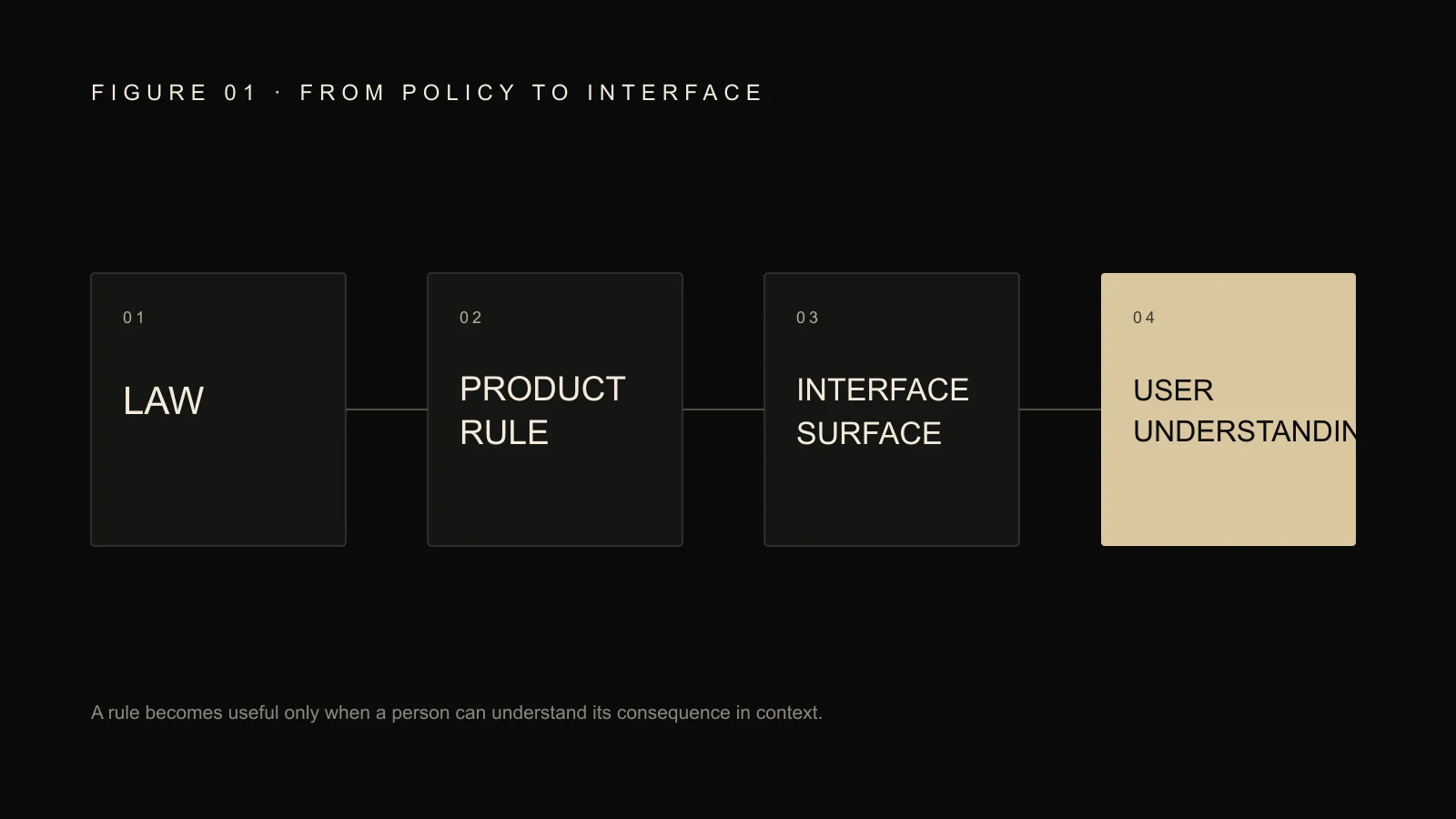
The shift is from policy to interface
Regulation is often discussed as if it lives in documents, legal reviews and compliance folders. Users experience it somewhere else. They experience it in the interface.
Does the product tell a person when they are interacting with an AI system where the law requires that disclosure? Can generated or manipulated content be identified where applicable?
Is the role of AI clear, or does the product deliberately blur the line between human and machine output? These questions are regulatory questions, but they are also design questions.
A disclosure that technically exists but appears after the user needed it is weak product design. A label that nobody understands is not much better. A warning shown on every screen until people stop seeing it is compliance theatre.
The interesting work begins when teams treat transparency as part of the product architecture.
A new product surface is appearing
Modern software already has surfaces dedicated to trust. Permission prompts explain why an app wants a camera. Payment interfaces explain price and renewal.
Security screens show active sessions. Privacy controls expose data choices. AI now needs its own equivalent.
Call it the trust surface.
It is the set of product elements that answer, at the right moment:
Is AI involved?
What is it doing?
What is the source of this output?
Can the system be wrong?
Is content generated, modified or merely assisted?
What control does the user have?
Where can the user learn more?
Not every product needs every answer in every screen.
The point is that AI provenance and behavior can no longer be treated as invisible implementation details.
August 2 is not the only date
One reason the AI Act is easy to misunderstand is that it does not arrive as a single switch.
Different provisions have different application dates.
The Commission’s AI Act Service Desk states that transparency obligations become enforceable from August 2, 2026. It also notes a transition for certain systems already on the market before that date: providers have until December 2, 2026 for the marking and detection obligation referenced under Article 50(2).
Other high-risk provisions operate on later timelines.
This matters because “Is my AI product compliant?” is usually the wrong first question.
The better questions are:
1. What role do we play under the Act?
2. What type of system or model are we providing or deploying?
3. Which obligations actually apply to that role and system?
4. On what date?
5. Which obligations must become visible in the product itself?
That is a mapping problem before it is a checkbox problem.

General-purpose AI is now an infrastructure issue
The Act also matters below the application layer.
Providers of general-purpose AI models have obligations around technical documentation, information for downstream providers, copyright policy and public summaries about training content.
For product teams building on top of external models, the practical implication is not that every startup becomes a foundation-model regulator.
It is that model provenance becomes part of supplier architecture.
Which model is used?
Who provides it?
What documentation exists?
What changes when the model is swapped?
Which downstream responsibilities remain with the product company?
The more AI becomes infrastructure, the less acceptable it becomes to treat the model layer as an anonymous API call.
The strongest products will make compliance feel native
Bad compliance feels bolted on. A banner appears because legal asked for it. A modal interrupts a workflow.
A disclosure is written in language nobody outside the company understands.
Good compliance is quieter. It appears exactly when context changes. It explains instead of merely warning. It creates a record where a record is useful.
It lets the user inspect provenance without forcing every user to become a lawyer.
That is the real design opportunity in the AI Act.
European regulation may force companies to expose information they previously kept invisible. The teams that do this well will not simply be “more compliant.”
Their products may feel more trustworthy.
What to do this week
For a team shipping an AI feature in Europe, a useful first pass is surprisingly practical.
Create an inventory of every place where AI affects the user experience.
For each one, record:
model/provider
input data
output type
whether the user knows AI is involved
whether content is generated or modified
what disclosure exists
what control exists
what source/provenance information exists
relevant AI Act role and deadline to verify
Then review that inventory with appropriate legal expertise.
The key is not to start with a 90-page policy.
Start with the product.
Because that is where the regulation eventually becomes real.
Verdict
The AI Act is often framed as a constraint on AI development. For product design, its more interesting effect may be architectural. AI systems are being pushed to explain themselves.
Not completely. Not perfectly. Not all at once. But enough that transparency is becoming a real software surface. The next generation of AI products will not be judged only by what they can do.
They will also be judged by how clearly they tell us what they are doing.