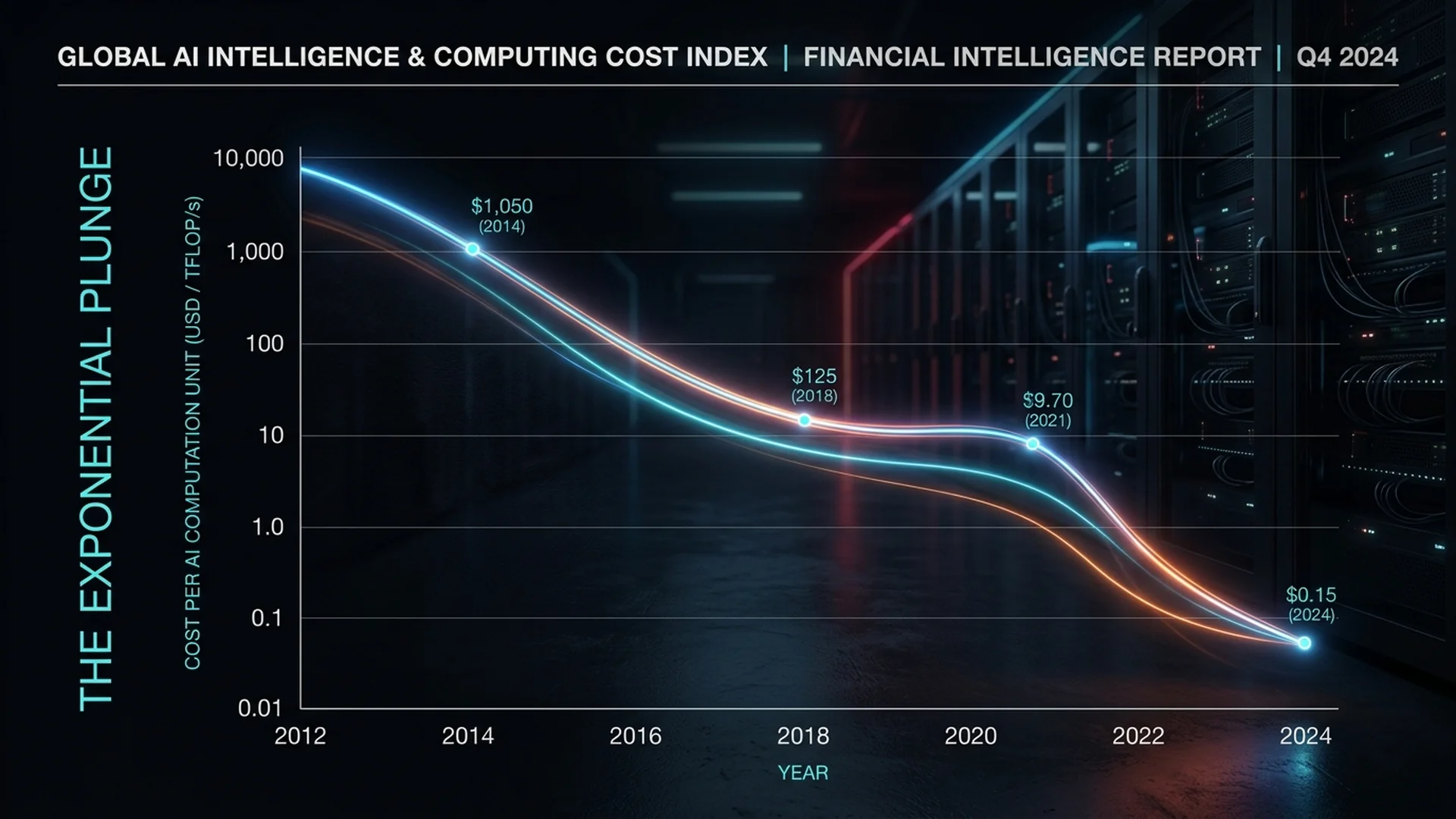
We spend a lot of time asking how intelligent AI is becoming.
The more disruptive question may be how cheap intelligence is becoming.
A new analysis from independent research institute Epoch AI estimates that, since 2023, the cost of achieving a fixed level of AI performance has fallen by roughly 47% every quarter.
That works out to about 13× cheaper every year.
Not token prices.
Not the cost of one specific model.
The price of buying the same level of capability.
And according to Epoch's comparison with other transformative technologies, nothing else moved this fast.
Not computers.
Not lithium-ion batteries.
Not DNA sequencing.
Not electricity.
If that trend survives even partially, the AI economy is about to get very strange.
The price of “thought” is collapsing
Epoch AI researchers Luke Emberson and David Roodman looked at model performance and cost across five benchmarks covering mathematics, hard sciences and games of skill.
Their question was simple:
How much does it cost today to buy the same level of AI performance that was expensive a year ago?
The answer was dramatic.
Across the five benchmarks, Epoch estimates an average cost decline of about 47% per quarter since 2023.
That means a task requiring a certain level of AI capability could cost roughly one-thirteenth as much a year later if users continually moved to the cheapest model capable of doing it.
On some mathematics benchmarks, the decline was even faster: roughly 50% to 52% per quarter.
Game-based puzzles were slower, at around 39% to 43% per quarter.
But “slower” here is doing heroic work.
Those are still extraordinary rates of cost decline.
Faster than batteries. Faster than compute. Faster than DNA sequencing.
Epoch compared the trend with historical cost improvements in other technologies.
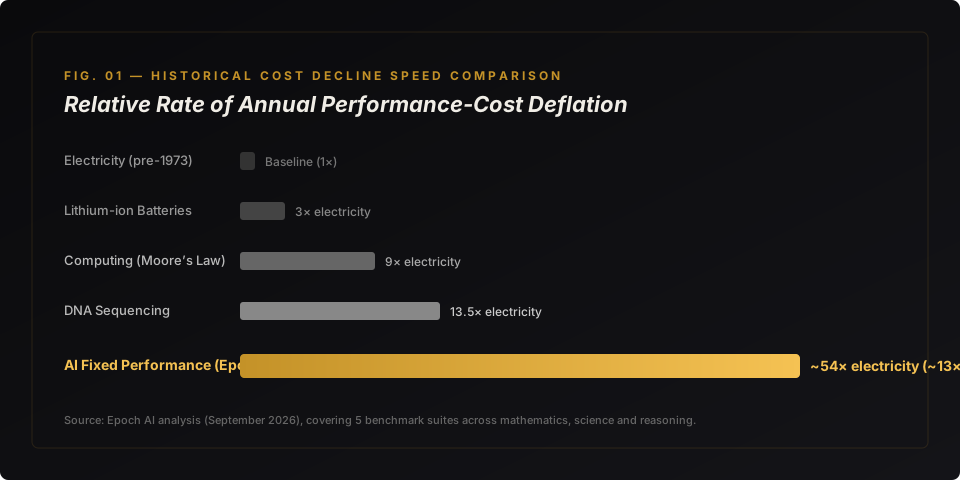
Its headline comparison is wild.
The estimated decline in AI performance cost is around:
4× faster than DNA sequencing
6× faster than computing
18× faster than lithium-ion batteries
54× faster than the historical decline in electricity prices through 1973
Those comparisons are not perfect apples-to-apples measurements, and Epoch explicitly warns against treating its bottom-line number as an exact physical constant.
But the direction is hard to ignore.
AI is not only improving.
Old levels of intelligence are being commoditized at extreme speed.
That may end up mattering more economically than the launch of any single frontier model.
Yesterday’s miracle becomes next year’s cheap API call
This is the part that changes how you should think about AI releases. A capability can arrive at the frontier looking expensive, scarce and almost magical. Then competition catches up.
Models become smaller.
Inference gets optimized.
Chips improve.
Training techniques improve.
Developers find ways to use fewer tokens.
Open models copy part of the capability curve.
And the premium collapses.
Epoch found that the decline is especially violent when a capability first appears.
For newly achieved frontier performance levels, costs initially fell at an estimated 66% per quarter, equivalent to roughly 75× per year.
Two years later, the decline slows to around 32% per quarter, still about 4.7× per year.
In other words:
AI capabilities seem to launch as luxury goods and rapidly become utilities.
This explains why AI pricing feels broken
Look at the model market in 2026 and pricing can feel almost irrational.
A new flagship launches.
Months later, a smaller model gets surprisingly close. Then another provider undercuts it. Then an open-weight model appears.
Then the lab cuts prices again. The important unit is no longer simply “price per million tokens.” A cheap model that fails the task is expensive.
An expensive model that solves it in one pass may be cheap. What businesses actually buy is some combination of:
capability × reliability × speed × cost.
Epoch is trying to measure one of the most important parts of that equation: how much you must spend to reach a given performance threshold.
And that frontier is collapsing.
The implications are bigger than cheaper chatbots
If the cost of capable AI keeps falling this quickly, the interesting applications are not necessarily better chat windows. They are tasks where AI was previously too expensive to run continuously. Imagine an agent monitoring every support ticket.
A coding agent reviewing every pull request. A model checking every document entering a company. An AI tutor adapting to every student individually.
A security agent investigating every suspicious event. A personal assistant continuously sorting information in the background. Today, many of those workflows are limited by economics.
Running a powerful model thousands or millions of times adds up quickly. Make the same intelligence 10× cheaper and previously ridiculous products begin to look reasonable. Make it 100× cheaper and the product itself can change.
The real AI revolution may be abundance
The internet became transformative when connectivity stopped being scarce. Computing exploded when processing power became cheap enough to disappear into everyday objects. Digital photography took over when taking another photo effectively cost nothing.
AI may be moving toward the same threshold. When intelligence is expensive, we reserve it for important requests. When intelligence becomes cheap, we spend it everywhere.
Software starts reasoning before every action. Games generate dynamic characters continuously. Cameras understand scenes locally.
Apps rewrite interfaces for individual users. Tiny companies run workflows that previously required entire departments. Eventually, asking software to “think about this” may become as economically unremarkable as asking a database to run a query.
That would be a much bigger shift than a chatbot getting a better benchmark score.
But there is a giant caveat
The headline number needs context.
Epoch's result is based on five benchmarks, not every real-world task.
Benchmarks can be optimized for. Performance on a math problem is not the same thing as reliably doing useful office work for eight hours.
The analysis also assumes a user who constantly switches to the cheapest model capable of achieving the required performance. Real companies do not behave that way.
They care about migration cost, latency, integrations, security, contracts, uptime and whether changing a model breaks production. Epoch also notes that its dataset spans only around three years and remains noisy.
So “13× cheaper every year” should not be interpreted as a law guaranteeing another 13× drop every twelve months forever. It is a measurement of what has happened across the studied performance frontiers so far.
That is still remarkable.
There is another paradox
Cheaper AI does not necessarily mean we will spend less money on AI. History often produces the opposite result. When something useful becomes dramatically cheaper, people use much more of it.
If AI inference becomes 10× cheaper but companies run 100× more inference, total spending still rises. That may already explain part of the apparent contradiction in the industry. Models are becoming cheaper.
At the same time, companies are building enormous data centers and buying huge amounts of compute. Those two things can both be true. The cost per unit of intelligence falls while demand for intelligence explodes.
The next moat may not be the smartest model
If intelligence keeps getting cheaper this quickly, simply possessing a strong model becomes a weaker advantage over time. Today's frontier becomes tomorrow's commodity. That shifts value elsewhere:
proprietary data,
distribution,
trusted user relationships,
workflows,
hardware,
agent permissions,
integration,
latency,
and products that know what to do with abundant intelligence.
The model still matters.
But the shelf life of a capability advantage may keep shrinking.
The Zerionia view
The biggest AI story of 2026 may not be which company has the smartest model.
It may be that intelligence itself is undergoing one of the fastest cost collapses ever measured for a transformative technology.
A 47% quarterly decline will not continue forever.
It does not need to.
Even a substantial slowdown would radically change what software can afford to do.
For the last few years, we asked:
What can AI do?
The next question is different:
What happens when almost everyone can afford to make it do that?
That is where things get interesting.
Key numbers
~47% average decline in cost per quarter for a fixed level of AI performance since 2023
~13× cheaper per year
39–43%/quarter decline on game-based puzzles
50–52%/quarter decline on math benchmarks
~66%/quarter initial decline for newly reached frontier capabilities
~32%/quarter decline around two years later