Most AI products have a meter running behind them.
Every prompt.
Every output.
Every agent loop.
Every user.
Somewhere, somebody is paying for tokens or cloud compute.
Apple is now pitching a very different model:
Buy the machine. Run the AI yourself.
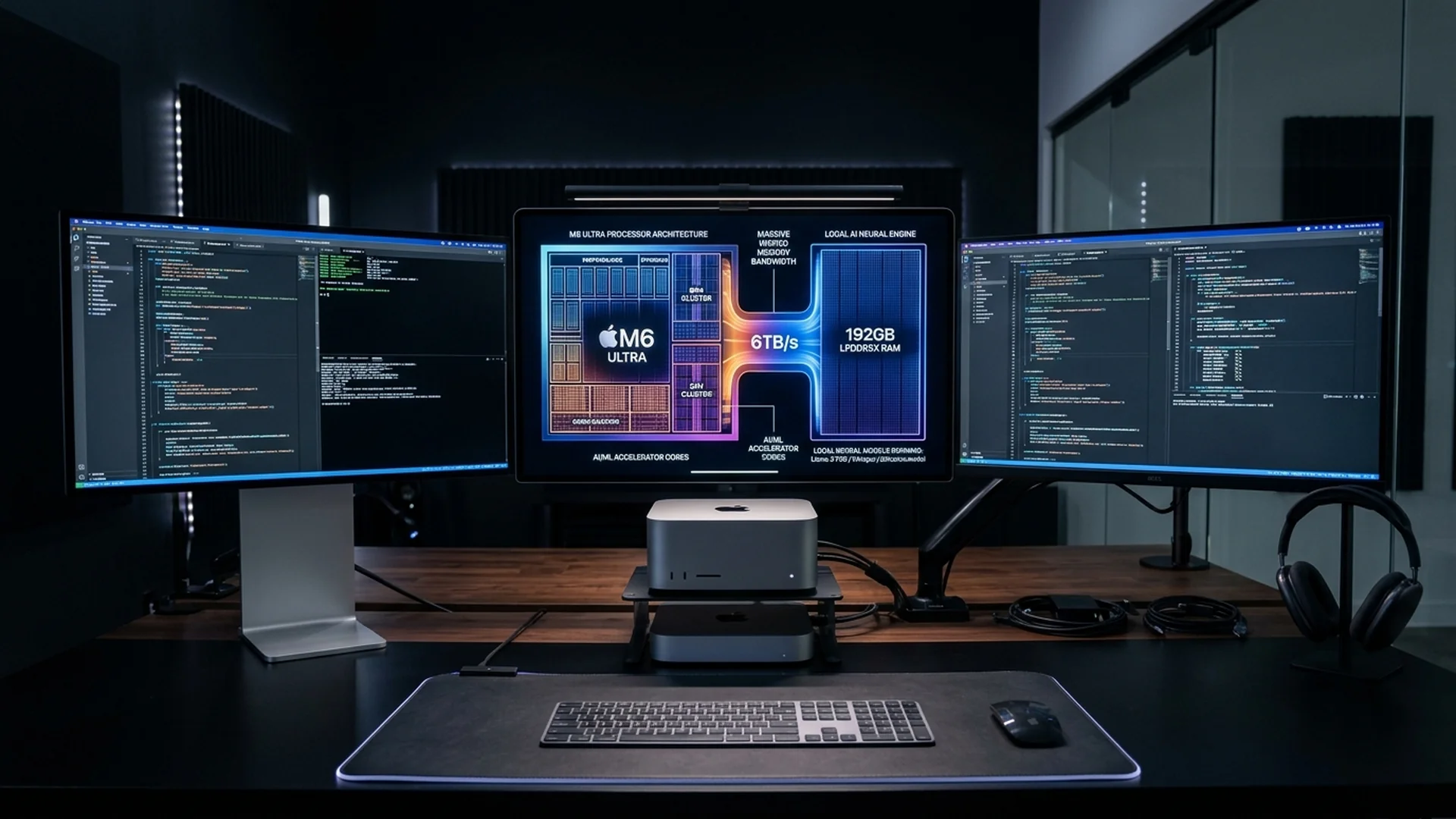
The new Mac mini and Mac Studio are available now, and Apple is pushing both devices much more aggressively as local AI hardware.
For companies watching their inference bills explode, that is an interesting proposition.
The new Mac mini is explicitly an AI box
Apple's new Mac mini ships with either M6 or M5 Pro. Apple says the M6 model delivers up to four times faster AI performance than the previous generation in selected workloads. More interesting than the benchmark is the positioning.
Apple describes the Mac mini as suitable for always-on agentic computing and local AI workflows.
That is unusual language for a mainstream desktop.
The company clearly wants businesses to imagine fleets of small Macs running agents, local models and automation without constantly sending work to cloud GPUs.
Mac Studio goes much further
The new Mac Studio uses M5 Max or M5 Ultra.
The M5 Ultra configuration supports up to 512GB of unified memory and 1.2TB/s of memory bandwidth.
That matters for large models.
Unlike conventional PCs where CPU memory and GPU memory are separate pools, Apple Silicon uses unified memory.
Large models can therefore access a very large shared memory space without being constrained by the VRAM limits common on individual consumer GPUs.
It does not magically make every model fast.
But it allows configurations that would otherwise require expensive workstation or server hardware.
Four Mac Studios, one trillion-parameter model
Reuters reports that Apple demonstrated a trillion-parameter AI model running across a cluster of four Mac Studios powered from a single wall outlet.
That sentence needs an important qualifier.
Apple did not demonstrate a trillion-parameter model running on one ordinary Mac.
The point was clustering.
The latest Mac Studio supports high-speed connectivity that lets multiple machines work together on distributed inference.
For teams that need large local models, that opens a strange new category between a desktop workstation and a traditional GPU server.
Local AI changes the cost model
Cloud AI is convenient because capacity scales instantly. It also means cost scales with usage. If an application becomes popular, inference can become one of its largest expenses.
Local infrastructure flips the equation. The company pays upfront for hardware. Then the marginal cost of another prompt is mostly electricity, maintenance and depreciation.
There is no API invoice increasing every time an employee asks another question. That can be extremely attractive for predictable workloads.
Examples include:
internal document assistants,
code search,
private copilots,
media processing,
repetitive batch inference,
local agents,
and sensitive enterprise workflows.
“No token bill” does not mean free
This is where the marketing needs reality. A Mac Studio can cost thousands of dollars. High-memory configurations cost much more.
Companies still pay for electricity, engineering, model licenses, deployment and maintenance.
Hardware also ages.
Cloud inference can remain cheaper when workloads are irregular or small. And frontier models may still only be available through hosted APIs. So the choice is not “free local AI versus expensive cloud AI.”
It is a capacity-planning decision.
Privacy is the other argument
Local inference has another advantage. Data does not necessarily need to leave the machine. For companies processing source code, internal documents, unreleased product plans or customer data, that can simplify the trust model.
This does not automatically make local AI secure. Models, operating systems and applications can still leak data. But fewer network transfers mean fewer external dependencies.
Apple has spent years turning privacy into a consumer product message. It is now applying a similar philosophy to enterprise AI infrastructure.
Nvidia and Microsoft are not standing still
Apple is entering a market dominated by very different ecosystems. Nvidia owns much of the modern AI compute stack. Windows remains overwhelmingly dominant on enterprise desktops.
Cloud providers offer infrastructure that can scale far beyond anything a stack of Macs can deliver. Apple does not need to replace those systems everywhere. It only needs to make local inference compelling enough for a new category of workloads.
The Mac mini may be especially interesting here. At $899 in the U.S. for the M6 configuration, it is cheap enough to be deployed almost like an appliance.
The Zerionia view
The cloud-versus-local AI debate is becoming less ideological.
It is becoming economic.
For years, local AI was mostly discussed by privacy enthusiasts, researchers and hobbyists. Now the question is moving into finance departments. How many tokens are we buying?
How predictable is the workload?
How sensitive is the data?
Would owning the compute be cheaper?
Apple clearly thinks enough companies will answer yes.