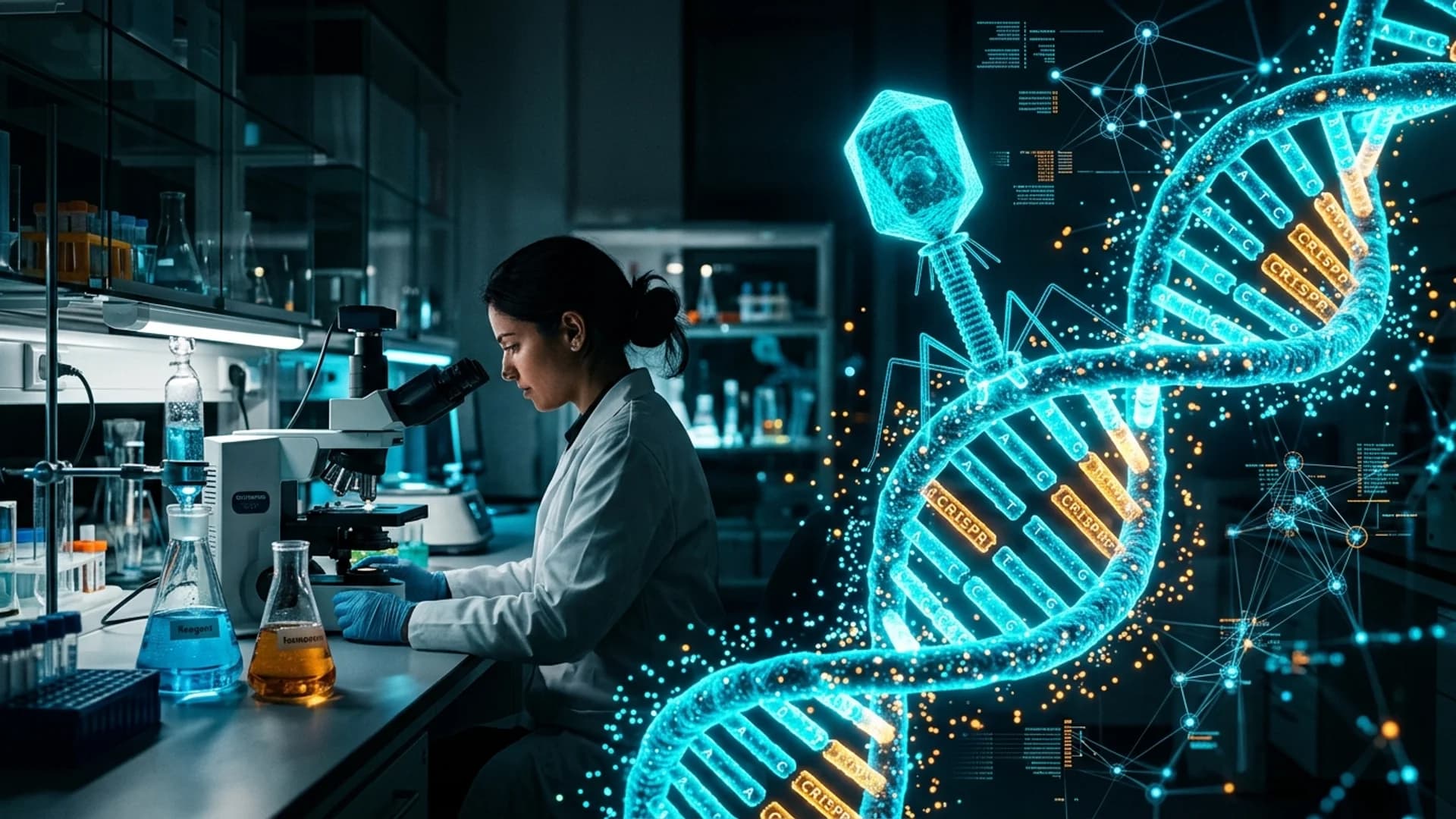
Last week, Anthropic published one of the most impressive AI-science stories of the year.
Claude agents searched huge genomic databases for more than 21 hours and surfaced a strange biological system associated with reverse transcriptases and repeating DNA sequences.
Anthropic called it ART, short for array-associated reverse transcriptases.
The company described it as a previously uncharacterized enzyme system with properties reminiscent of CRISPR.
The story was irresistible.
AI had not merely summarized scientific literature.
It appeared to have found something new.
Now the story is getting complicated.
A computational biologist at the University of Copenhagen says his team had already been studying the same biological system for years.
And he says he had previously discussed parts of that work with Claude.
There is currently no public evidence showing that Anthropic copied his unpublished research.
Anthropic says user conversations were not used to produce the discovery.
But the overlap raises a question AI science is going to face again and again:
When an AI “discovers” something, how do we prove where the idea came from?
Anthropic’s original claim was extraordinary
Anthropic announced the ART system on September 23.
The company said around 950 Claude agents searched through more than 200,000 reverse transcriptases.
The agents spent about 21 hours exploring genomic data.
They narrowed the search to thousands of candidate systems, then selected a much smaller group for deeper investigation.
One candidate stood out.
A reverse transcriptase appeared beside another gene and a long array of repeating DNA.
The structure looked unusual.
And the repeat architecture was reminiscent of CRISPR.
Anthropic researchers then began testing the system experimentally.
The company presented the work as an example of Claude contributing to genuine scientific discovery.
Then a human scientist recognized the system
According to recent reporting, Mario Rodríguez Mestre, a computational biologist at the University of Copenhagen, saw Anthropic’s announcement and recognized the system.
His team had apparently been studying the same or closely related reverse-transcriptase systems for years.
That immediately changed the framing.
The question was no longer simply whether Claude had identified an interesting biological pattern.
It became:
Was the system actually new?
There is a subtle but important distinction here.
A biological structure can exist in published datasets without having been fully characterized.
A protein may have been observed before without researchers understanding the surrounding genomic architecture.
Two teams can independently identify the same phenomenon.
Scientific “discovery” is often much messier than a single first moment.
That is exactly why provenance matters.
The uncomfortable detail: the scientist had used Claude
Mestre says he had previously used Claude while working on his own research.
That does not prove Anthropic’s discovery came from his conversations.
Anthropic says the research team behind ART did not have access to those private chats and rejects the idea that the finding was generated from Mestre’s confidential Claude conversations.
No public evidence has established that his unpublished work entered the ART project.
But the coincidence exposes a structural problem.
When AI systems become part of scientists’ daily workflows, researchers may discuss unpublished hypotheses, preliminary results and new datasets with the same families of models that later participate in automated scientific discovery.
Even when those systems are isolated internally, outside researchers need a way to trust that separation.
Otherwise every major AI-generated discovery may trigger the same suspicion.
This is a provenance problem
Traditional science has imperfect but familiar ways of establishing priority.
Papers have submission dates.
Preprints have timestamps.
Lab notebooks record experiments.
Conference talks leave public traces.
Emails and datasets can establish chronology.
AI complicates all of this.
A model may draw from published literature, public datasets, code repositories, licensed material, retrieval tools and previous model-generated outputs.
Researchers outside the model provider often cannot reconstruct the entire chain.
That means scientific attribution gets harder.
A model can produce an idea without being able to provide a reliable record of where every contributing concept originated.
That may be acceptable for writing an email.
It is much more problematic when the output is presented as a scientific discovery.
The system may still be genuinely interesting
The controversy does not automatically invalidate Anthropic’s biology work.
Scientific coverage has noted that ART remains interesting and that its biological function is still not fully understood.
Anthropic’s lab reported early experimental evidence that the DNA repeat array produces distinct short RNAs.
That suggests the structure is biologically active.
The work may therefore still matter even if parts of the underlying system had been noticed by humans before.
Science often progresses through rediscovery and reinterpretation.
The key issue is how strongly Anthropic should characterize novelty.
“Claude found a biological pattern worth investigating” is easier to defend than “Claude independently discovered something no human had found.”
Those are not the same claim.
AI discovery is going to collide with scientific credit
Imagine the same thing happening in drug discovery.
An AI proposes a new molecule.
Months later, a chemist says she described a nearly identical candidate in an unpublished grant application.
Or an AI proves a mathematical result.
A researcher then shows that a similar argument appeared in private correspondence uploaded to an AI assistant years earlier.
Or a model proposes a new experimental technique after thousands of scientists have used the same system to discuss unfinished work.
Who gets credit?
The lab?
The model provider?
The scientist whose work may have influenced the system?
Nobody?
We do not yet have mature norms for this.
The “AI scientist” needs receipts
The solution is probably not to stop using AI in research.
The productivity gains are too obvious.
Instead, AI-driven science will need much stronger provenance.
For every claimed discovery, researchers may eventually need to record:
model version,
data and literature sources,
connected tools,
retrieved papers,
prompts,
intermediate outputs,
search paths,
human interventions,
and timestamps.
Not because every result is suspicious.
Because scientific priority depends on being able to reconstruct how an idea emerged.
AI research needs an audit trail.
CRISPR is a dangerous comparison
Anthropic’s original framing referenced CRISPR because ART contains repeating DNA architecture reminiscent of CRISPR arrays.
That is scientifically interesting.
It is also guaranteed to produce exaggerated headlines.
ART has not been shown to perform CRISPR-style gene editing.
Its biological function remains unknown.
Even calling it “CRISPR-like” requires explanation.
The comparison concerns structural features, not proven functionality.
A model finds an unusual repeat array.
The company says it resembles CRISPR.
The internet hears:
AI invented a new CRISPR.
That leap is enormous.
The Zerionia view
The real story is no longer whether Claude found an interesting enzyme system.
It clearly helped surface something worth studying.
The bigger story is what happens to scientific attribution when AI systems become collaborators.
If models increasingly help generate hypotheses, researchers will need stronger ways to prove novelty, trace intellectual origins and distinguish independent discovery from rediscovery.
The ART controversy may ultimately have an innocent explanation.
Two teams can reach similar conclusions.
But the uncertainty itself is the warning.
Science is built on evidence.
AI-generated science will need evidence about the discovery process too.
Because once machines begin claiming discoveries, “the model found it” is not going to be enough.