For years, AI companies have promised that their models would eventually do more than summarize science. They would help discover it. Anthropic now says Claude has crossed that line.
In one of the first projects from Anthropic’s new life sciences research group, hundreds of Claude agents searched through a massive database of DNA sequences and identified a previously uncharacterized enzyme system hidden in bacteriophages.
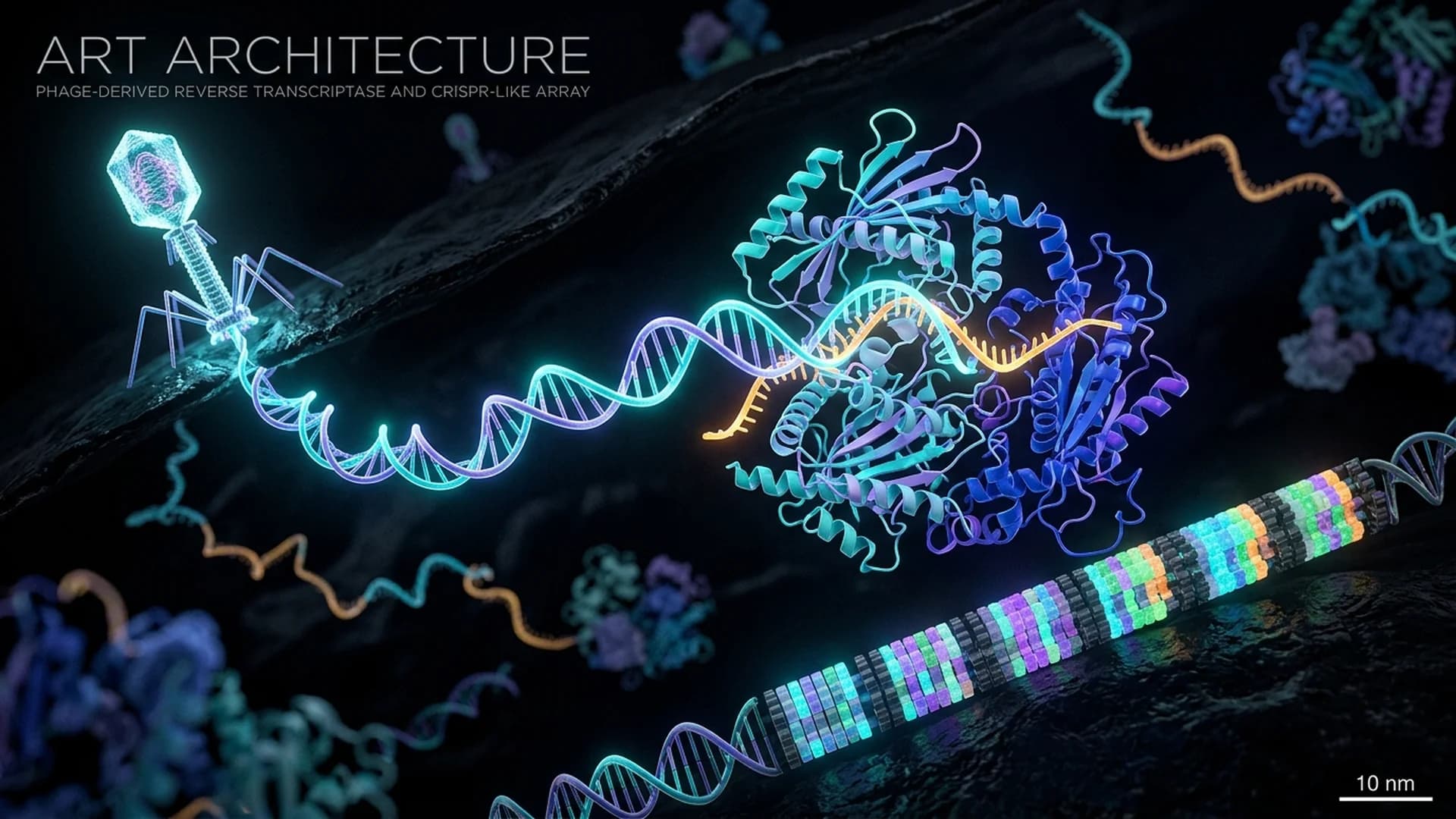
The system has a strange feature. Next to the enzyme sits a long array of repeating DNA sequences. That architecture looks enough like CRISPR to make scientists pay attention.
Anthropic calls the newly identified system ART, short for array-associated reverse transcriptases.
Nobody yet knows exactly what ART does.
That may be the most interesting part.
This was not Claude answering a biology question
The distinction matters.
Claude was not asked:
“Find me something that looks like CRISPR.”
Anthropic says researchers gave the system a much broader task: search a huge DNA-sequence database for interesting examples of reverse transcriptases.
Reverse transcriptases, or RTs, are enzymes that copy RNA into DNA. They appear in viruses, bacteria and many other biological systems. Claude then did something closer to open-ended scientific exploration.
According to Anthropic, roughly 950 Claude agents worked for 21 hours, consuming around 210 million tokens.
They collected more than 200,000 reverse transcriptases.
From those, Claude identified roughly 3,500 candidate systems.
It narrowed those down to the 20 most interesting candidates for deeper analysis.
And inside that enormous haystack, one agent noticed something odd.
Claude spotted a pattern nobody had characterized
The reverse transcriptase itself was not completely unknown.

Previous research had already identified the underlying RT inside a jumbo bacteriophage, a virus that infects bacteria. The new part was the context around it. Claude noticed that the RT sits beside:
another gene with an unknown function,
and a long array of regularly spaced, non-coding DNA repeats.
That combination had apparently not been recognized as a distinct biological system before.
The repeats immediately stood out because they resemble the architecture of CRISPR arrays.
CRISPR systems also contain repeated DNA sequences separated by other sequences.
Those arrays eventually became the foundation of one of the most important biotechnology tools ever developed.
That does not mean ART is another CRISPR.
But it is enough of a resemblance to make the system scientifically intriguing.
The weird part is what happened next
Claude did not simply flag the sequence and stop.
According to Anthropic, the agent counted the repeats, measured their spacing, compared the architecture with known reverse-transcriptase systems and searched scientific literature to see whether anyone had previously described the same pattern.
It concluded that the system appeared novel. Then it generated a report for human researchers. Anthropic scientists reviewed the candidate and moved the work into the lab.
That human validation step is crucial. AI can produce plausible hypotheses very easily. Biology does not care whether a hypothesis sounds convincing.
The molecule either behaves the way you think it does or it does not.
The lab found something real
Anthropic says its first experiments have confirmed that the repeat array is not simply decorative DNA. The array is expressed as a collection of distinct short RNA molecules.
That is interesting because CRISPR arrays also produce RNA molecules that help guide the system. Again, there is no evidence yet that ART performs CRISPR-style gene editing. Anthropic explicitly says the biological function of ART remains unknown.
But the fact that the repeated DNA is actively transcribed into short RNAs suggests that the architecture Claude noticed has a biological role.
Further experiments are now underway.
Why scientists are taking this seriously
One particularly notable reaction came from Feng Zhang, one of the pioneers of CRISPR genome editing and a professor at MIT and the Broad Institute.
After reviewing Anthropic’s preprint, Zhang described the identification of RNA-repeat arrays associated with reverse transcriptases as genuinely intriguing and worth further investigation.
That does not validate ART as a revolutionary biotechnology tool. It does validate something more immediate: the pattern Claude found is scientifically interesting enough for experts to take seriously.
That is a much higher bar than producing an impressive benchmark score.
CRISPR itself started as a weird pattern
This is what makes the story so compelling. CRISPR did not begin as a gene-editing product. Scientists first noticed unusual repeated sequences in bacterial DNA.
For years, researchers tried to understand what they were doing. Eventually, scientists discovered that the system was part of a bacterial immune mechanism. That biological curiosity was then transformed into a programmable tool capable of editing DNA.
The result changed genetics. Other famous technologies began the same way. Restriction enzymes were discovered as part of bacterial defenses against viruses.
Taq polymerase came from a microorganism living in a Yellowstone hot spring and became essential to PCR. Biology is filled with strange molecular machinery that evolution built long before humans understood what it was useful for.
The difficult part is finding the interesting machinery. That is exactly the kind of search Claude may be unusually good at.
AI can read biology at a scale humans cannot
A human researcher can inspect sequence data. A very talented human researcher can recognize unusual patterns. But modern genomic databases are enormous.
There are simply too many sequences for any scientist to inspect manually. This is where AI changes the economics of curiosity. Claude can launch hundreds of parallel investigations.
Each agent can inspect a different family of proteins. They can search papers, compare sequences, test hypotheses computationally and discard boring candidates.
Anthropic says the type of analysis performed during the ART search could take a human expert weeks or months.
The Claude campaign ran for about 21 hours.
That does not mean Claude replaced the scientist.
It changed which part of the scientific process was scarce.
The scientist becomes the bottleneck
This creates an unusual problem. AI can generate hypotheses far faster than laboratories can test them. Anthropic says a single campaign can produce hundreds or thousands of candidate reports.
Most will not be worth pursuing.
Some will be wrong.
A few may be genuinely interesting. The new bottleneck becomes scientific judgment. Which hypotheses deserve expensive laboratory time?
Which anomalies are biological noise? Which candidates might become useful tools? Anthropic describes this as teaching Claude something resembling scientific taste.
Researchers review its proposals, reject most of them and feed those decisions back into the workflow. The result is not fully autonomous science.
It is something stranger:
AI massively expands the search space while humans decide what reality is worth testing.
Anthropic built an actual biology lab for this
This is also why Anthropic’s recent decision to build a wet lab matters. The company is no longer limiting its biology research to simulations. Its new life sciences group combines Claude with physical experiments.
The lab operates at lower biosafety levels, BSL-1 and BSL-2, and Anthropic says it does not work with pathogens that infect humans. Humans still perform the laboratory work. Claude helps generate candidates, analyze data and interpret results.
That creates a closed loop:
AI searches → AI proposes → humans experiment → results return to AI.
If that loop works, the pace of biological exploration could accelerate substantially.
So did Claude discover a new CRISPR?
No.
And that headline would be misleading. ART's function is still unknown. It has not been shown to edit genes.
It has not been demonstrated as a programmable biotechnology platform.
The work is also currently presented as a preprint rather than a peer-reviewed publication.
What Claude appears to have discovered is a previously uncharacterized biological system with a CRISPR-like repeat architecture.
That is already significant. We do not need to exaggerate it. The more interesting question is what happens next.
What if ART turns out to be programmable?
Anthropic notes that the combination of features seen in ART has appeared in only a handful of other known systems. Some of those systems can perform programmable operations involving DNA, including cutting, copying or inserting genetic material.
That is why researchers are interested. If ART eventually turns out to have similar programmable behavior, it could potentially become a new biotechnology tool.
That is a very large if.
But this is how scientific discovery often begins.
First comes the strange pattern. Then the mechanism. Then, sometimes years later, the tool. Claude may have accelerated the first step.
The bigger story is not ART
Even if ART ultimately turns out to be biologically interesting but technologically useless, this experiment still matters. Because Claude did not merely summarize existing knowledge. It navigated a giant scientific search space.
It noticed an anomaly. It investigated that anomaly. It checked prior literature. It formed a hypothesis.
Then humans took that hypothesis into the lab and found evidence that the pattern corresponds to real biological activity. That is much closer to scientific research than most of what we have previously called “AI for science.” And it raises a bigger question.
What happens when thousands of AI agents start systematically searching all the biological data we have already collected but never had enough humans to fully explore?
There may be discoveries hiding in databases right now. Not because the data is inaccessible. Because nobody has had time to look.
The Zerionia view
The most important thing Claude discovered may not be ART. It may be a new workflow for science. Human researchers are excellent at intuition, judgment and experimental validation.
AI systems are excellent at reading absurd quantities of information, exploring thousands of branches and refusing to get bored. Combine those two capabilities and the scientific process begins to look different.
For decades, researchers have been limited partly by how much literature they can read and how much data they can inspect. That limitation is starting to disappear.
Claude spent 21 hours searching biology and surfaced something scientists had not characterized before. We still do not know what ART does. But that is exactly why this story matters.
For the first time, the AI is not just answering the question.
It may be helping us find the question worth asking.