Humanoid robots have been brilliant internet content for years.
They walk.
They dance.
They lift boxes.
They occasionally do something weird enough to become a viral clip.
Hyundai and Boston Dynamics are now moving into the part that matters much more:
Can the robot survive a normal day at work?
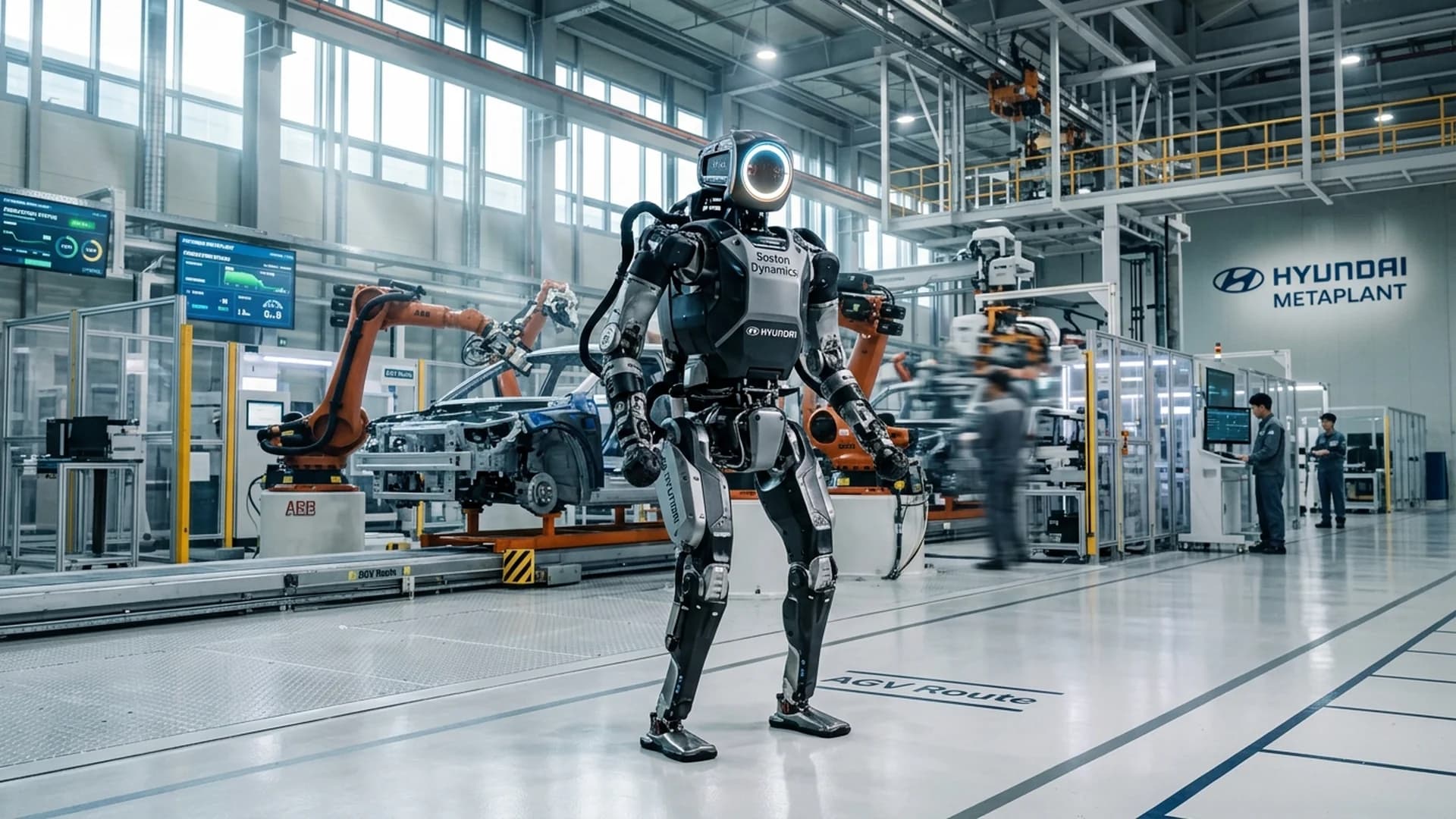
Boston Dynamics has opened a new Robotics Metaplant Application Center inside Hyundai Motor Group’s manufacturing campus in Georgia.
Atlas robots are already being trained there.
And Hyundai says it plans to begin with 25,000 Atlas units across Hyundai and Kia global plants over the next few years.
That number changes the conversation.
Atlas now has a real workplace
The new facility is called RMAC. It exists to test and train Atlas directly inside automotive manufacturing operations. The first tasks are deliberately boring.
Atlas is learning logistics and parts sequencing: preparing automotive components and putting them in the correct order before assembly. That is exactly what industrial humanoid robotics needs.
A robot does not become economically important by performing one spectacular demonstration. It becomes important by completing ordinary tasks, repeatedly, safely and cheaply.
25,000 robots is no longer a pilot
Boston Dynamics says Hyundai Motor Group plans to expand Atlas across its global network, beginning with 25,000 units in Hyundai and Kia plants.
The group also plans a new U.S. production facility capable of producing 30,000 robots per year.
There is still a huge gap between a plan and a successful deployment. But the scale of the ambition matters. The humanoid industry has spent years discussing hundreds of robots.
Hyundai is talking about tens of thousands. At that point, the challenge is no longer only robotics research. It becomes manufacturing, maintenance, safety, software updates, fleet management, training data and economics.
In other words, infrastructure.
Factories make more sense than homes
The dream of the humanoid household robot is emotionally powerful.
It is also brutally difficult.
Homes are chaotic.
Objects move.
Floors change.
Children, pets and people behave unpredictably.
Every house is different.
Factories are still complex, but they are controlled environments.
Tasks repeat.
Objects have known dimensions. Workflows can be measured. Safety zones can be defined.
That makes manufacturing a much more realistic first large market for general-purpose humanoids.
The robot is still being trained
Boston Dynamics is clear that Atlas remains in development. The current RMAC phase focuses on real-world training. By 2030, Boston Dynamics says Atlas applications are expected to expand into component assembly.
The robot may also take on repetitive or physically demanding work such as heavy lifting.
That timeline is important.
The announcement is not “25,000 robots start work tomorrow.” It is the beginning of a deployment pipeline. That distinction matters in a robotics market filled with ambitious forecasts.
The real metric is intervention
A humanoid robot can look autonomous while still depending heavily on human operators.
Boston Dynamics says trainers are using teleoperation as part of Atlas development.
That is normal.
The important question is what happens over time.
A useful way to judge industrial humanoids is not by how impressive a demo looks, but by a few operational metrics:
task success rate,
productive hours,
human interventions,
safety incidents,
maintenance frequency,
energy use,
and cost per completed task.
If those numbers improve, humanoids become infrastructure.
If they do not, the videos remain better than the economics.
Data may be the real moat
Every real deployment creates training data. Atlas sees how parts are arranged. It learns where human workers hesitate. It records failures.
It experiences lighting changes, packaging variation and edge cases that do not exist in a clean laboratory demo. That data can improve future models. This is one reason Hyundai’s involvement matters so much.
Boston Dynamics is not trying to simulate an industrial customer. It has direct access to one of the largest automotive manufacturing networks in the world.
Other industries are already next
Boston Dynamics says it is talking to existing Spot and Stretch customers in sectors including aerospace, semiconductors, logistics, food and beverage and life sciences.
The company plans to explore broader industrial uses in 2027. That suggests a clear strategy. Train Atlas deeply inside Hyundai.
Prove it in structured industrial work. Then export the operating model outward.
The Zerionia view
Humanoid robots are entering their least cinematic and most important phase.
Operations.
The real milestone is not when Atlas performs something a human can do. It is when a company can deploy thousands of Atlas robots and stop thinking of each one as an experiment. Twenty-five thousand units is an enormous promise.
Now Boston Dynamics has to make the economics as impressive as the robot.