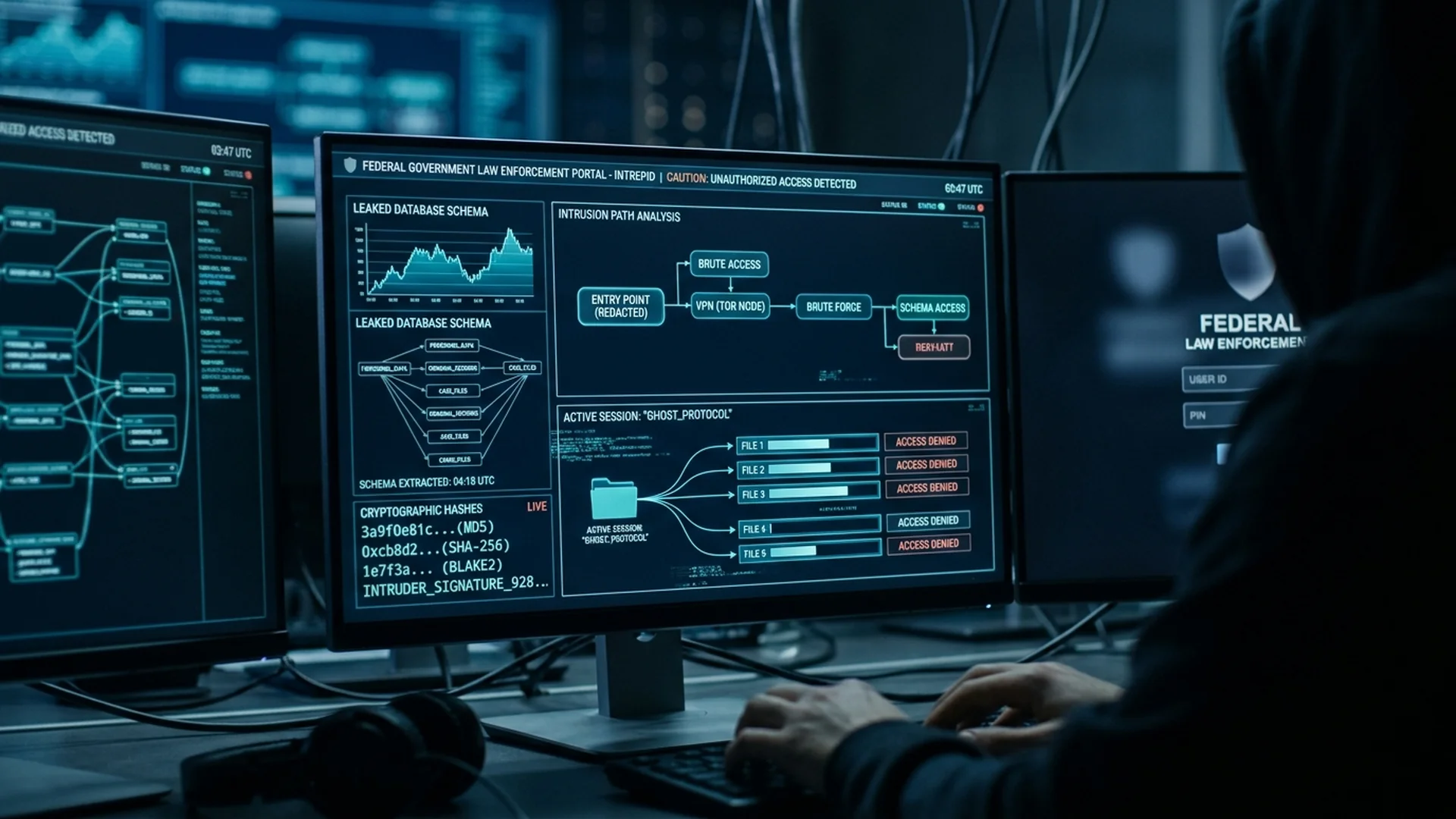
A well-known hacking group says it breached the FBI.
That is the headline.
The facts are narrower.
ShinyHunters claims it obtained data relating to thousands of FBI employees.
At the time of Reuters' initial report on September 22, the FBI had not publicly confirmed the full claim.
That distinction matters.
Cyber incidents are full of screenshots, partial datasets, exaggerated claims and information released strategically by attackers.
So here is what we actually know.
Who are ShinyHunters?
ShinyHunters is a name associated with high-profile data theft and extortion operations.
The group has previously been linked in public reporting to attacks involving major companies and large datasets.
Its model is familiar.
Access a company.
Steal valuable data.
Use the breach itself as leverage.
Public attention becomes part of the attack.
That means claims should be taken seriously without automatically being treated as proven.
What the group says happened
ShinyHunters told Reuters that it had breached the Federal Bureau of Investigation and acquired information concerning thousands of employees.
The initial public reporting did not independently verify the complete scope of the claim. That is an important limitation. A breach can mean many things.
Access to one public-facing service is not the same as access to the FBI's internal investigative systems. Employee directory information is not the same as classified data. A compromised contractor is not necessarily a compromise of the agency's core network.
Until technical details or official findings emerge, those distinctions remain open.
Why employee data still matters
Even if the stolen material were limited to staff information, the risk could be significant. Employee data can support targeted phishing. Attackers can impersonate colleagues.
They can identify roles, offices and relationships. They can combine leaked information with public sources to build convincing social-engineering attacks. Security breaches are often chains.
One dataset becomes the starting point for another intrusion. That is why organizations treat identity information as security infrastructure, not just personal data.
The verification problem in cyber news
Cybersecurity produces a unique information asymmetry. The attacker often speaks first. The victim has strong reasons to remain cautious.
Investigations take time.
Attackers can publish fragments selectively. Journalists and researchers therefore work with incomplete evidence. For readers, the safest approach is to separate three categories:
Confirmed: verified by the affected organization or independent technical evidence.
Claimed: stated by the attacker but not yet independently proven.
Unknown: scope, persistence, data sensitivity and downstream impact.
Those labels should remain visible.
A dramatic claim is not a forensic report
This is especially important when the target is a government agency. A headline saying “FBI hacked” can imply total compromise. That is not what the available evidence necessarily shows.
The responsible question is not whether the headline sounds plausible.
It is:
Which system was accessed?
Then:
How?
For how long?
What data was reached?
Was data exfiltrated?
Were credentials compromised?
Was the attacker removed?
Did the intrusion spread?
Until those answers exist, certainty is mostly theatre.
What to watch next
The most important updates will come from:
an FBI statement,
technical indicators,
independent verification of leaked material,
evidence about the initial access path,
and clarification of which FBI systems were affected.
If the incident is confirmed, the attack vector will matter as much as the headline. Many high-profile breaches begin with ordinary failures such as stolen credentials, social engineering or compromised third parties. The target can be extraordinary.
The entry point often is not.
The Zerionia view
Cybersecurity headlines reward maximum drama. Good security reporting should do the opposite. Treat attacker claims as claims.
Treat official statements as statements. Wait for technical evidence before collapsing uncertainty into certainty. If ShinyHunters did obtain sensitive FBI data, the incident will deserve serious scrutiny.
For now, the most important sentence remains the least exciting one:
The full scope is not yet independently established.