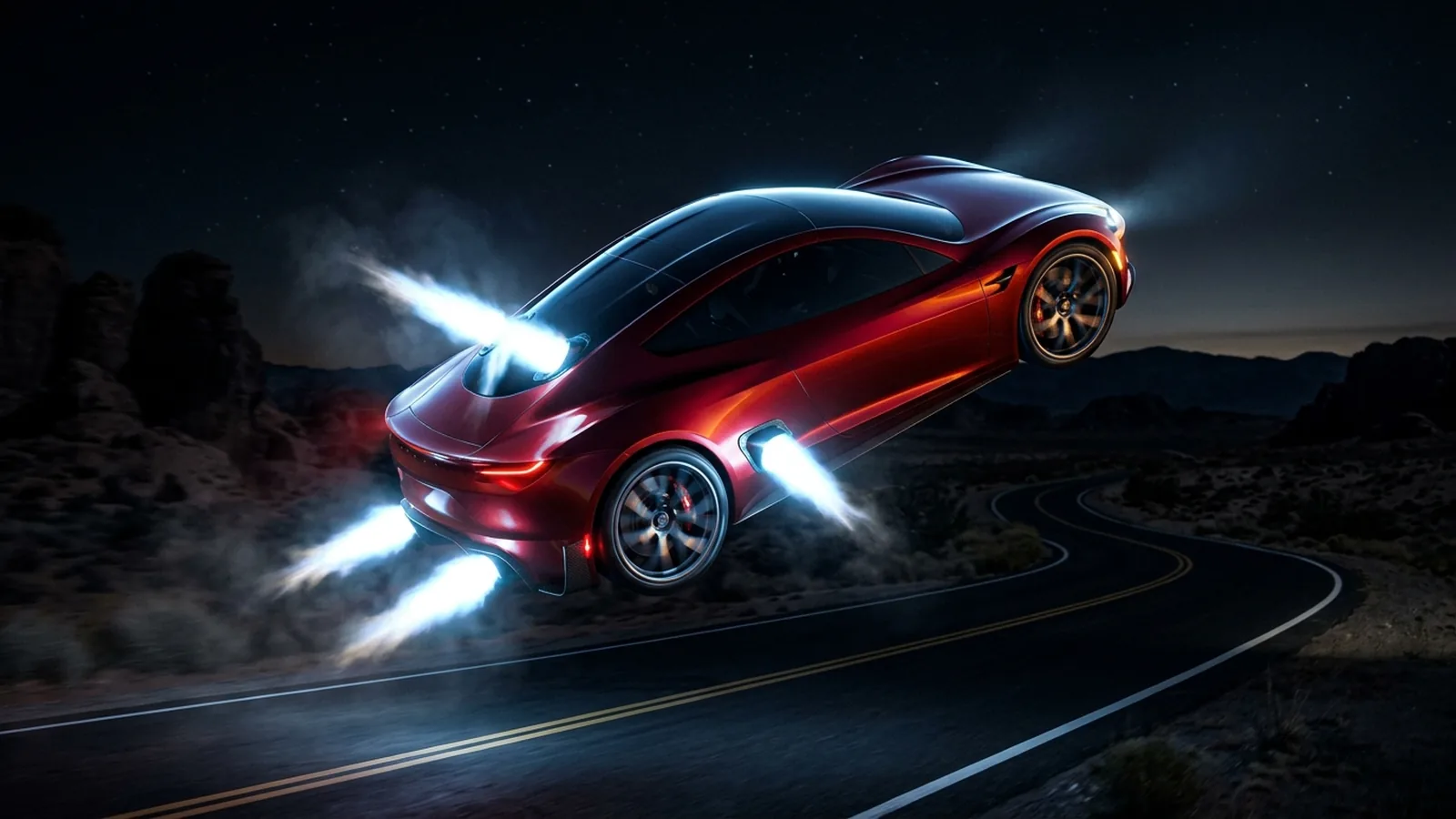
Tesla has finally shown the next-generation Roadster.
And the ridiculous part is that the car actually left the ground.
At a live event in Texas, Tesla demonstrated a prototype Roadster using a mix of active aerodynamics, a powerful suction system and SpaceX-inspired cold-gas thrusters. One version drove up an inverted ramp, went upside down, launched into the air, rotated and returned to the ground.
Another demonstration showed the car jumping over a line of Tesla vehicles. This is not an AI render or a CGI teaser. Tesla demonstrated the hardware in front of an audience. That does not mean flying cars have suddenly arrived.
But the Roadster has officially become much stranger than a fast electric sports car.
What Tesla actually showed
Tesla is splitting the Roadster into three versions.
The Performance version is the road-focused model. Tesla says it uses active aerodynamics and a multi-mode suction system designed to generate huge downforce, even at very low speeds.
The Thrust version adds rear cold-gas thrusters. Tesla claims it can accelerate from 0 to 60 mph in under one second.
Then there is Rocket.
That version adds ten cold-gas thrusters around the car and is designed to create thrust not only forward, but upward and rotationally. It is also a one-seat vehicle. And Tesla says it is not currently road legal.
So yes, the Roadster can “fly.” But the most extreme version is closer to an experimental road-going rocket than a normal production sports car.
How does a car even do this?
Tesla says the thruster system uses compressed air stored in Carbon Fiber Overwrapped Pressure Vessels. Those tanks feed electrically controlled cold-gas thrusters that can make tiny corrections extremely quickly.
The goal is not sustained airplane-style flight. Think short bursts of enormous force. The Roadster can use them for acceleration, stabilization and brief airborne maneuvers.
Tesla's engineering team says the system was developed with SpaceX expertise.
That is where the Roadster stops looking like a traditional car project and starts looking like Musk asking two engineering teams, “what if we just did something absurd?”
The upside-down trick is different
One of the most visually insane parts of the demo was the car driving upside down. That relies heavily on the suction system rather than the rocket thrusters.
Tesla says powered fans pull air from underneath the car, creating enough suction to generate downforce even when the car is stationary. In theory, enough suction means the car can stick to a surface even when gravity wants it somewhere else.
Race cars already use aerodynamic downforce. The Roadster takes that idea into cartoon territory.
There is a giant catch
The car shown is still a prototype.
Production is now planned for 2028.
The Roadster was originally revealed in 2017 and has been delayed repeatedly, so Tesla's dates deserve skepticism until customer cars actually begin shipping.
Tesla is also making performance claims that have not yet been independently verified.
And the Rocket trim creates obvious regulatory and safety questions.
Musk himself has been unusually direct about this, saying safety is not the main goal of the Roadster and that people whose number-one priority is safety probably should not buy it.
That may be refreshingly honest.
It is also not the sentence regulators usually dream about.
Does anyone actually need this?
Absolutely not.
And that may be the point.
Tesla's mainstream business increasingly revolves around autonomy, robotics and cheaper vehicles. The Roadster is a halo product. It exists to create the kind of reaction that practical cars do not.
A Model Y is useful.
A car doing a barrel roll with SpaceX hardware gets millions of views. Tesla has spent years trying to regain some of the technological mystique it had during its early growth. A flying Roadster is not going to fix the economics of the company.
It can absolutely fix the “when was the last time Tesla showed something completely insane?” problem.
Zerionia view
The best way to understand the new Roadster is not as the beginning of the flying-car era. It is as an engineering flex. Tesla took technologies that normally belong in aerospace, motorsport and experimental vehicles and forced them into one product.
Whether customers ever receive the full Rocket version in 2028 is a separate question. Today, Tesla proved one thing: The Roadster can leave the road.
And apparently the car industry's “please do not try this at home” era has officially begun.